



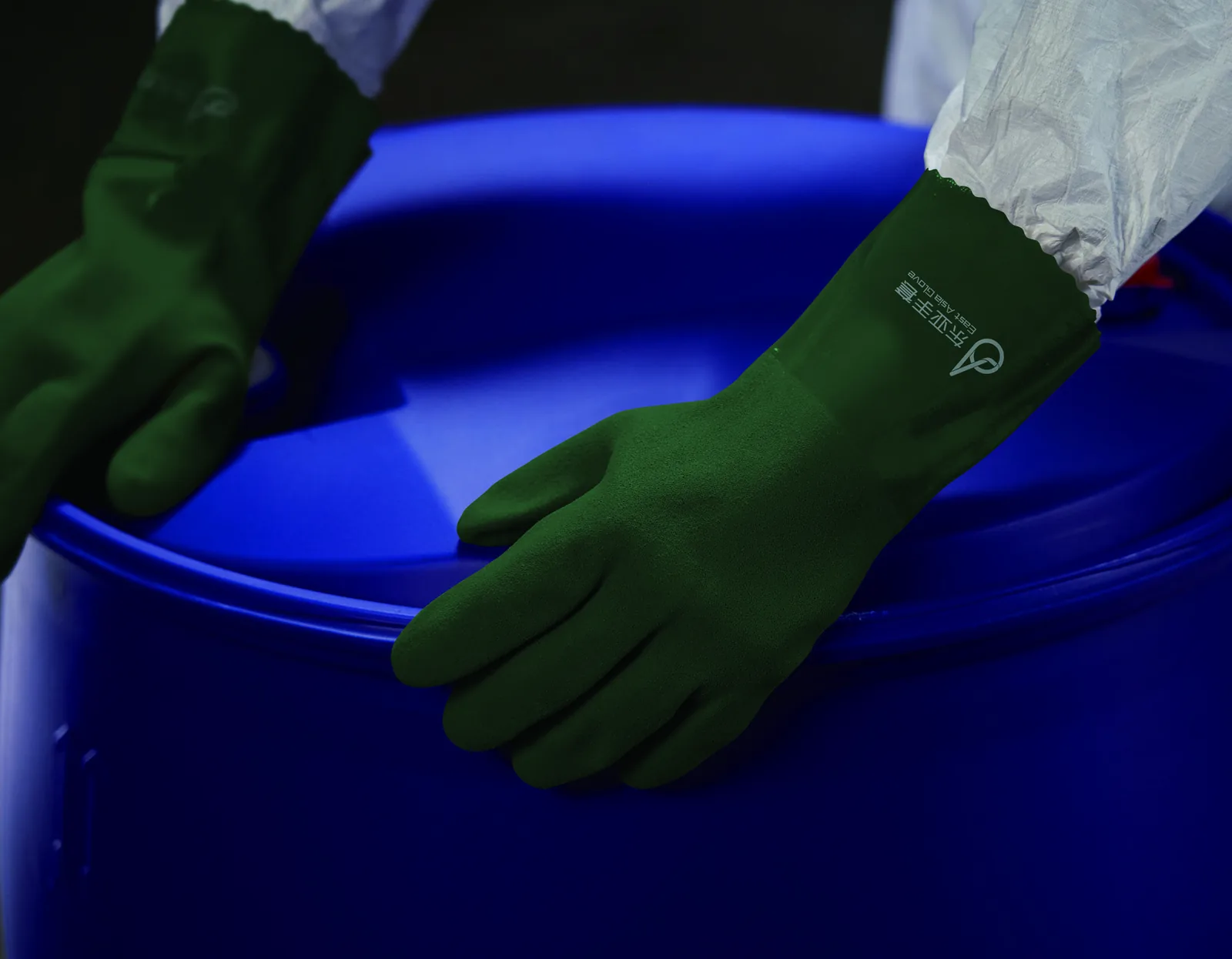
Chemical-resistant glove sourcing often begins with a material name: nitrile, PVC, PVA or silicone. That is a useful starting point, but it is not enough to make a purchasing decision. Chemical resistance depends on the exact substance, concentration, temperature, exposure time, glove construction and test method.
For importers, distributors and safety buyers, the better question is not simply ‘Which material is best?’ It is ‘Which exact glove model has evidence that matches our task and target market?’ This guide provides a structured way to reach that answer.
Begin with the hazard and exposure scenario
Document the chemical name, concentration, physical state and working temperature. Then define how contact occurs: occasional splash, repeated handling, prolonged contact or immersion. A glove suitable for brief splash contact may not be suitable for continuous exposure.
Also record mechanical demands. A chemically compatible glove may still fail early if the task involves abrasion, sharp edges, rough surfaces or repeated flexing.
- Chemical identity and concentration
- Contact type and expected duration
- Working temperature
- Grip, abrasion and dexterity needs
- Required cuff length and coverage
Reusable nitrile gloves
Reusable nitrile gloves are commonly considered for chemical handling because nitrile can offer useful resistance across many oils, greases and selected chemicals. Construction matters: coating thickness, finish, liner, cuff and manufacturing process all affect performance and comfort.
Do not transfer evidence from one nitrile glove to another. EA GLOVE model 339S has its own supplied EU type-examination evidence; that evidence does not automatically cover other nitrile models or product families.
PVC gloves
PVC-coated gloves are widely used for wet, oily and general industrial handling. They can provide a practical combination of coverage, grip and durability, with different finishes and liners available for different work conditions.
Buyers should compare the exact PVC formulation, coating construction, length and liner. Model 806S has model-specific supplied EU type-examination evidence, but the scope must remain tied to 806S and be reviewed together with current declarations and production-conformity documents.
PVA gloves
PVA gloves are often evaluated for work involving selected organic solvents. Their important limitation is water sensitivity: water and high humidity can affect the material. That makes the complete exposure scenario essential.
A PVA model should be assessed against the exact solvent, concentration and contact conditions. Buyers should also review storage, handling and moisture-control requirements.
Silicone gloves
Silicone glove construction may be selected for model-specific thermal, cleaning, food-handling or electrical tasks. Silicone is not a blanket chemical-resistance solution. Liner, surface treatment, thickness and model design all matter.
For liquid-silicone models, ask for evidence related to the intended task rather than relying on the general properties of silicone.
Build a defensible document request
A useful supplier response should identify the exact model and document revision. Ask for the technical data sheet, applicable test report, current declaration for the target market and—where Category III PPE is involved—the relevant production-conformity evidence.
During shipment inspection, confirm that model markings, sizes, packaging and purchase specifications match the approved sample and document set.
- Exact model code and size range
- Current technical data sheet
- Applicable test methods and reports
- Declaration and market-specific documentation
- Production-conformity evidence where required
- Approved sample and shipment-inspection criteria
Frequently asked questions
Is nitrile always better than PVC for chemicals?
No. Suitability depends on the exact chemical, concentration, temperature, exposure duration and glove construction. Compare model-specific evidence for the real task.
Can one CE certificate cover an entire glove family?
Only when the certificate and supporting documentation explicitly define that scope. The supplied SATRA certificate names the S600/S600A/S600BA/S600C/S600BS product group, while the separate CTC evidence for 806S and 339S is model-specific. None of these certificates should be extended beyond its stated scope.
What should a buyer send when requesting a recommendation?
Send the chemical name and concentration, contact duration, temperature, mechanical demands, target market, quantities and required documentation.
Conclusion
Material comparison is the beginning of chemical-glove selection, not the conclusion. A reliable sourcing decision connects the real exposure scenario to an exact model, current evidence and clear inspection criteria.